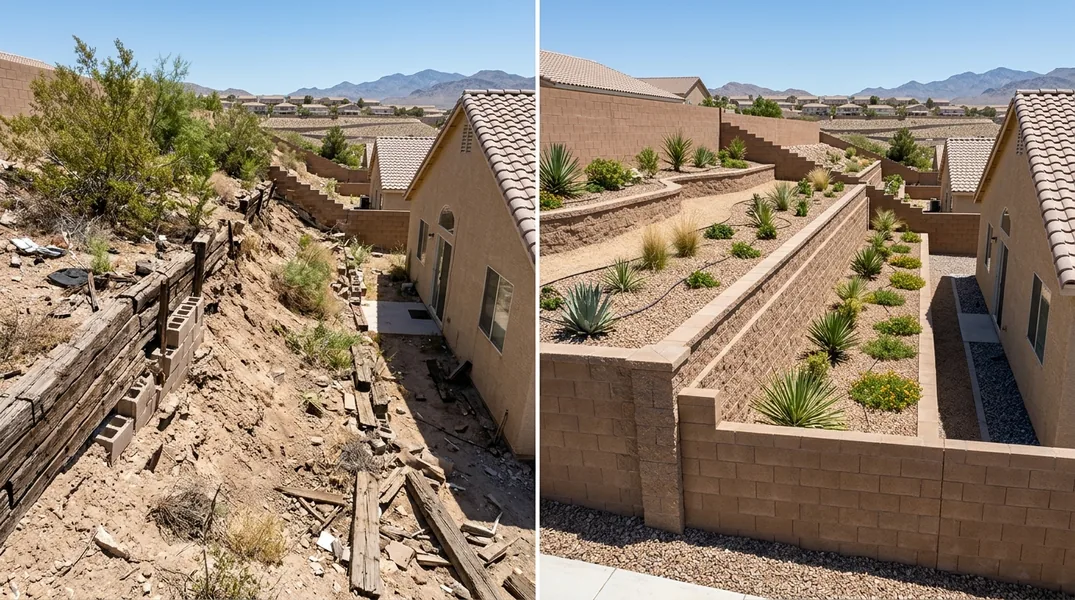
Understanding Why Retaining Walls Fail in Las Vegas
Retaining walls are essential landscape features in Las Vegas yards, holding back soil and creating level terraces on sloped properties. However, many homeowners are surprised to learn that these structures don't last forever. In fact, retaining wall failure is one of the most common landscape problems we encounter, and understanding why it happens is the first step toward prevention.
The primary reason retaining walls fail in our region comes down to soil pressure and water management. When soil becomes saturated, it exerts tremendous lateral force against the wall. In Las Vegas, where we experience intense summer heat followed by occasional heavy rains, the ground undergoes significant expansion and contraction cycles. This constant movement, combined with poor drainage, places enormous stress on the wall structure. Additionally, many older retaining walls were built without proper reinforcement or drainage systems, making them particularly vulnerable to failure over time.
Another critical factor is the quality of initial construction. Not all Retaining Wall Installation work is created equal. Walls installed without proper gravel backfill, drainage pipe, or geotextile fabric are essentially ticking time bombs. The foundation and compaction methods matter tremendously, and shortcuts taken during installation often lead to premature failure years down the road.
The Most Common Warning Signs of a Failing Retaining Wall
Spotting early warning signs can save you thousands of dollars in Retaining Wall Repair costs. The most obvious indicator is a leaning retaining wall. If your wall is tilting away from the soil it's supposed to retain, this means the structural integrity has been compromised. This tilt typically worsens over time and can eventually lead to complete collapse if left unaddressed.
Another telltale sign is horizontal cracks or breaks in the wall face. These fractures indicate that the wall is under extreme stress and the material is beginning to fail. You might also notice vertical displacement where different sections of the wall have shifted relative to each other. Water seepage through the wall is another critical warning sign that drainage systems have failed, allowing soil moisture to accumulate behind the structure.
Bowing is particularly concerning and often indicates a bowing block wall that's experiencing catastrophic pressure from behind. If you notice the wall face bulging outward, especially in the middle section, this is an emergency situation that requires immediate professional attention. Additionally, watch for soil erosion at the base of the wall, settling in the retained area, or vegetation growing at odd angles on the slope above the wall.
How Soil and Drainage Problems Lead to Wall Failure
The relationship between soil composition, water drainage, and retaining wall longevity cannot be overstated. In Las Vegas, many properties have clay-heavy soil that retains moisture exceptionally well. While this might seem beneficial for plant growth, it's actually terrible for retaining walls. When water accumulates behind the wall, hydrostatic pressure builds up, pushing the wall outward with tremendous force. Over time, this pressure overcomes the wall's structural capacity, leading to failure.
Proper drainage systems are designed to prevent this exact scenario. A well-constructed retaining wall includes a perforated drain pipe running along the base, surrounded by gravel backfill and protected by geotextile fabric. This system allows water to flow freely through the backfill and out through the drain pipe, rather than accumulating behind the wall. Unfortunately, many older walls lack these essential components, or the drainage systems have become clogged with sediment over the years.
Surface water runoff also plays a significant role in wall deterioration. If water from rain or irrigation flows across the top of the wall or down its face, it can erode the mortar between blocks, weaken the overall structure, and seep into the soil behind the wall. This is why proper grading around the wall and appropriate landscaping practices are crucial for long-term performance. Homeowners who maintain good drainage practices and keep water away from their retaining walls experience significantly fewer problems.
Recognizing a Leaning Retaining Wall: When Professional Help Is Essential
A leaning retaining wall is not a cosmetic issue that can wait for a convenient time to address. This is a structural problem that will progressively worsen. The lean indicates that the wall has lost its ability to withstand the lateral forces acting upon it, and each season of freeze-thaw cycles, soil movement, and water infiltration will make the situation more critical.
You can check for a lean by standing back and looking at the wall profile against a straight edge or by using a level against the wall face. Even a slight tilt of more than half an inch over the height of the wall is concerning. Many homeowners mistakenly believe that a leaning wall is still functional because it hasn't collapsed yet. This is dangerous thinking. A wall that's actively leaning is in active failure mode and should be evaluated by a professional as soon as possible.
The good news is that a leaning wall doesn't necessarily require complete Retaining Wall Replacement. Depending on the cause and severity of the lean, structural reinforcement or targeted repairs might be sufficient. However, only a qualified contractor can make this determination. We recommend getting a free estimate from Las Vegas Retaining Wall to assess your specific situation. Call us at (725) 726-4860 to schedule an evaluation.
Concrete Retaining Walls in Las Vegas: Durability and Common Failure Points
Concrete Retaining Walls are popular in the Las Vegas area because concrete is durable and can handle our intense sun and temperature fluctuations. However, concrete is not immune to failure. Concrete walls can develop cracks from thermal stress, freeze-thaw damage, reinforcement corrosion, or poor construction practices. When concrete cracks, water penetrates into the material, which accelerates deterioration and compromises structural integrity.
One specific failure mode for concrete walls is spalling, where the surface layer of concrete breaks away and flakes off. This often occurs when water enters the concrete and freezes, expanding and contracting the material from within. Another common issue is reinforcement bar corrosion, particularly in concrete walls that were built near the surface without adequate concrete cover. As the rebar rusts, it expands and creates internal pressure that causes the concrete to crack and fail.
The good news is that concrete walls, when properly installed with adequate reinforcement, drainage, and maintenance, tend to last longer than block or timber alternatives. Regular inspection and prompt attention to small cracks can prevent major failures. If you have a concrete retaining wall showing signs of distress, professional assessment is critical to determine whether repair is possible or if replacement is necessary.
Taking Action: When to Repair, Reinforce, or Replace Your Retaining Wall
The decision between repair, reinforcement, and replacement depends on several factors including the wall's age, the severity of damage, and the underlying cause of failure. Minor cracks, small leans, or localized damage might be addressed through targeted Retaining Wall Repair work. This could include sealing cracks, improving drainage, adding reinforcement cables or plates, or rebuilding a small section of the wall.
More significant problems, such as a pronounced lean or extensive structural damage, might require reinforcement solutions. These could involve installing tiebacks, adding buttress walls, or installing internal reinforcement systems. These solutions can extend the life of your wall by many years and are often more cost-effective than full replacement. However, they require expertise and proper engineering to implement correctly.
Complete replacement becomes necessary when the wall is severely compromised, has failed in multiple locations, or when the underlying cause cannot be adequately addressed through repair. While replacement is the most expensive option, it provides a permanent solution and allows for incorporation of modern drainage systems and construction standards. To determine the best course of action for your property, contact Las Vegas Retaining Wall at (725) 726-4860 or visit our website to request a free estimate. Our experienced team will evaluate your wall, identify the root causes of any problems, and recommend the most practical and cost-effective solution for your specific situation.
Looking for a professional retaining wall contractor in Las Vegas? Las Vegas Retaining Wall responds fast for all your retaining wall needs.
Get a Free QuoteOur services: Retaining Wall Installation · Retaining Wall Repair · Retaining Wall Replacement