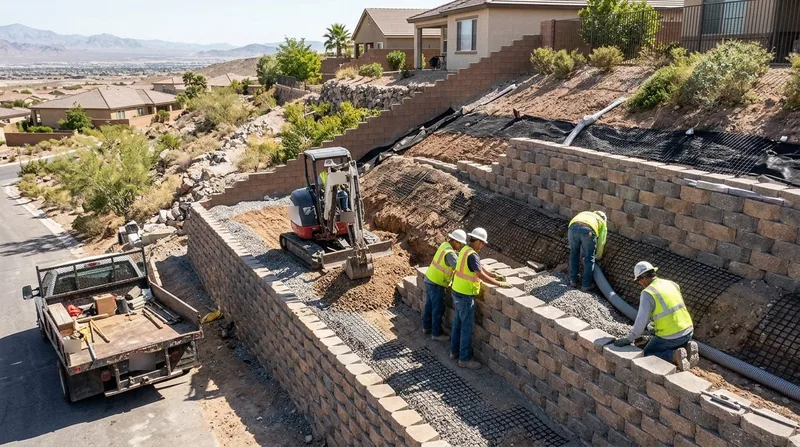




Slope stabilization and erosion control in Las Vegas protects hillside homes, driveways, and yards from washout, settlement, and collapse. Las Vegas spreads across desert terrain where homes climb alluvial fans toward the Spring Mountains, and dry washes like the Flamingo, Duck Creek, and Las Vegas Wash cut through neighborhoods in Summerlin, Centennial Hills, Paradise, and Enterprise. When heavy monsoon rains hit or caliche hardpan traps water beneath the surface, slopes fail fast. Collapsible and expansive soils settle when wetted, overwatered drip lines undermine banks, and sudden flash floods carve gullies through yards. We install terraced retaining walls, geogrid reinforcement, and drainage systems to stop erosion at the source and anchor your property for the long term. Call (725) 726-4860 for a free site assessment, or visit our retaining wall installation page to see how we build walls that hold.
Why Slope Stabilization Matters in Las Vegas: Desert Terrain and Water Traps
Las Vegas slopes fail for reasons unique to the Mojave Desert and this region's building patterns. Homes built on cut-and-fill lots in the 1970s through 2000s often rest on caliche, a hard mineral layer that sheds water instead of draining it. When drip irrigation systems run year-round or a single monsoon storm dumps rain on a hillside, water pools above the caliche and destabilizes the soil beneath. Collapsible soils, common in the valley floor and alluvial fans, compress and settle when saturated, pulling foundations and retaining walls downward. Expansive clay soils swell when wet and shrink when dry, cracking walls and shifting them out of plumb. The desert sun bakes landscape timbers, railroad ties, and stuccoed block walls, making them brittle and prone to cracking. Without proper slope stabilization and drainage, a stable-looking hillside can fail in a single wet season.
- We remove standing water and seepage by installing perimeter drainage systems and gravel-filled trenches that direct runoff away from the slope.
- We build terraced retaining walls with proper geogrid reinforcement to anchor soil and prevent sliding on steep grades.
- We stabilize cut banks and wash-side lots with erosion control fabric, riprap, and vegetation to slow water flow and bind soil.
- We repair leaning and bulging walls that signal internal water pressure and imminent collapse before they fail.
- We engineer solutions for homes above dry washes where flash floods scour foundations and undermine walls.
Proper slope stabilization prevents costly foundation repair, landscape loss, and property damage in Las Vegas neighborhoods where hillside lots are the norm.
Key info: Homes in Summerlin, Lone Mountain, and Centennial Hills sit on terraced hillsides where even small drainage failures trigger soil settlement and wall movement. A single overwatered landscape can destabilize a slope that has been stable for decades. We identify the water source and fix it before it becomes a structural emergency.
For more on how water damages retaining walls, see our guide to retaining wall drainage in Las Vegas. You can also check the Clark County Building Department permit requirements for slope work in your jurisdiction.
How We Stabilize Slopes in Las Vegas: Terracing, Geogrid, and Drainage
Slope stabilization in the Las Vegas desert requires a multi-layer approach. We start with a site walk to identify water sources, soil type, slope angle, and existing wall condition. We then design a system that combines proper grading, drainage, reinforced retaining walls, and erosion control. For steep slopes or heavy clay soils, we use geogrid reinforcement to lock soil in place and distribute weight evenly. For washes and erosion-prone banks, we install riprap, filter fabric, and native plantings that slow water flow and bind soil with root systems. For homes with caliche hardpan, we break through or route drainage around it so water does not pool and destabilize the slope.
- We excavate and profile the slope, removing loose soil and identifying the caliche layer or water table.
- We install perimeter drainage trenches filled with gravel and perforated pipe to intercept and redirect seepage.
- We build terraced retaining walls using block, stone, or poured concrete, backfilled with geogrid and compacted soil.
- We place filter fabric and riprap on exposed banks to control erosion and slow runoff velocity.
- We grade the top of the slope to shed water away from walls and foundations, with proper slope (minimum 2 percent).
- We test drainage after the first rain to confirm water is leaving the site and not pooling behind the wall.
A well-designed slope stabilization system in Las Vegas will hold for 20 to 30 years or more if drainage is maintained and the wall is not overloaded with a surcharge.
Real example: A home in Paradise with a leaning split-face block wall and water seeping from the toe was failing because a drip line on the uphill neighbor's property was running directly into the slope. We rerouted their irrigation, installed a drainage trench behind the wall, and rebuilt the lower three courses with geogrid reinforcement. The wall has been stable for four years with no new movement.
Learn more about our block and segmental retaining walls and boulder and natural stone walls for slope applications.
Slope Stabilization Methods and Materials
| Approach | Description | Best for |
|---|---|---|
| Terraced Block Walls with Geogrid | Split-face or solid CMU block walls built in tiers, each backed with geogrid reinforcement and compacted soil, creating a stable stepped profile. | Moderate slopes in residential neighborhoods, hillside lots in Summerlin and Centennial Hills, where block matches existing architecture. |
| Poured Concrete Walls with Drainage | Monolithic reinforced concrete walls with integral or external drainage pipes and weep holes, engineered for high water pressure and steep grades. | Steep hillsides, high water tables, wash-side properties, and homes where a single strong wall is preferred over multiple tiers. |
| Boulder and Natural Stone Walls | Large desert stone or boulders stacked with geotextile and drainage backfill, creating a permeable and visually integrated slope stabilization system. | Erosion-prone banks, washes, and properties where natural stone matches the desert landscape and water needs to drain freely. |
| Drainage Trenches and Rerouting | Perforated pipes, gravel-filled trenches, and surface swales that intercept seepage and direct it away from the slope toward storm drains or daylight. | Any slope where water infiltration is the primary failure mode, caliche traps water, or neighbor irrigation is destabilizing your property. |
| Erosion Control Fabric and Riprap | Nonwoven geotextile and stone riprap placed on banks to slow runoff velocity, prevent gully formation, and bind soil while vegetation establishes. | Exposed banks, wash sides, and slopes where grass or desert shrubs are being planted to stabilize soil long-term. |
Slope Stabilization and Erosion Control Cost in Las Vegas: What to Expect
The cost of slope stabilization and erosion control in Las Vegas depends on slope size, soil type, wall height, drainage complexity, and access. A small residential slope with a single terraced block wall and drainage may run $4,000 to $8,000. A larger hillside property with multiple tiers, geogrid reinforcement, and extensive drainage work can range from $12,000 to $30,000 or more. Wash-side properties or homes with severe erosion may require engineered solutions that cost $25,000 to $50,000 or higher. The best way to get an accurate figure is to request a free site estimate, where we measure the slope, identify water sources, and provide a detailed scope and price.
Factors that move the cost up include steep grades, poor soil conditions, caliche hardpan that must be broken, high water tables, proximity to structures or utilities, and the need for engineered drawings (required by Clark County for walls above 4 feet or supporting a surcharge like a driveway). Getting 2 to 3 estimates from licensed contractors is smart practice, so you can compare scope, materials, and timeline. Visit our pricing page for more detail on what drives cost in slope stabilization work.
We include travel and site assessment in our estimate process at no charge. Call (725) 726-4860 to schedule your free consultation, or go to our contact page to request an estimate online.
Slope Stabilization and Erosion Control Near Me: What Las Vegas Homeowners Should Know When Hiring
Hiring the right contractor for slope stabilization in Las Vegas means checking three things: licensing, insurance, and experience with desert soils and drainage. Nevada requires retaining wall contractors to be licensed and insured. Confirm they carry general liability and workers' compensation insurance, and ask for a certificate of insurance before work begins. A contractor who has worked on slopes in Summerlin, Centennial Hills, and Paradise will understand caliche, collapsible soils, and the water-trapping problems that plague this region.
Second, understand what permits you need. Clark County and Las Vegas city require a permit for retaining walls over roughly 4 feet tall or when the wall supports a surcharge like a driveway or structure. Some HOAs in Summerlin and other developments also require design approval before work starts. A good contractor will handle permitting or guide you through the process and explain what the local building department requires. Third, get multiple estimates and compare scope, materials, timeline, and warranty. Ask about drainage testing after installation, maintenance schedules for irrigation and grading, and what happens if the wall moves or water reappears after the job is done.
References from past slope stabilization work in Las Vegas neighborhoods are worth their weight in gold. Ask the contractor for three recent jobs on hillsides or wash-side properties, and follow up with those homeowners. A well-stabilized slope should show no new cracking, no water seepage, and no settlement for years after installation. For a free no-obligation estimate and to discuss your slope concerns, contact us today or call (725) 726-4860.
Slope Stabilization & Erosion Control in Las Vegas: Pricing Guide
| Service | Price | Details |
|---|---|---|
| Small slope with single terraced wall and drainage | $4,000 to $8,000 | Includes perimeter drainage, single block wall tier, geogrid, and grading. Typical residential hillside lot in Las Vegas or Paradise. |
| Medium slope with multiple tiers and comprehensive drainage | $12,000 to $25,000 | Two or three terraced walls, geogrid reinforcement, perforated drainage, riprap, and erosion control fabric on exposed banks. |
| Large or complex slope stabilization with engineered design | $25,000 to $50,000+ | Steep grades, poor soils, caliche breakout, high water table, wash-side location, or surcharge requiring engineered drawings and city approval. |
| Free site estimate | No charge | Includes slope measurement, soil and drainage assessment, material recommendations, and written price quote within 24 hours. |
| Travel and mobilization | Included | No separate mileage or travel fee within Las Vegas, Henderson, North Las Vegas, Boulder City, Paradise, Spring Valley, Enterprise, and Summerlin South. |
Indicative pricing, the exact cost depends on square footage, finish, and site access. Free personalized estimate within 24h at (725) 726-4860.


