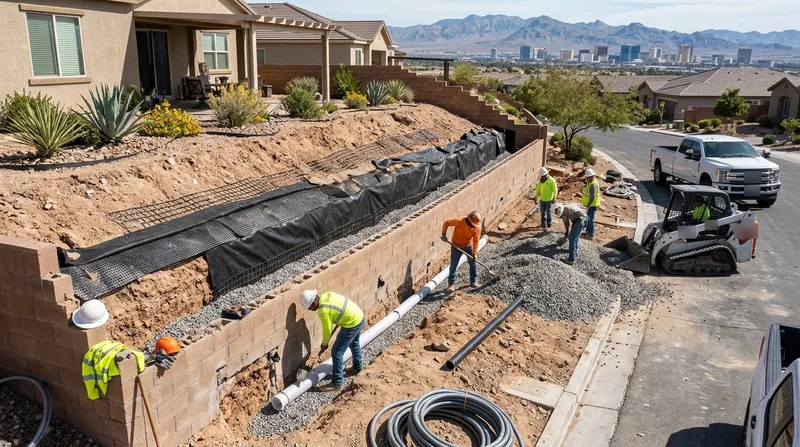




Retaining wall drainage in Las Vegas is the difference between a wall that lasts decades and one that fails in a few years. In the Las Vegas valley, where caliche hardpan traps water beneath the surface and sudden monsoon flash floods overwhelm unprepared landscapes, hydrostatic pressure is the silent killer of retaining walls. Whether your wall is stuccoed split-face block in a 1970s neighborhood, segmental pavers around a Summerlin pool, or stacked desert stone in Paradise, water behind the wall will push it forward, crack it, and eventually topple it. We install French drains, weep holes, gravel backfill systems, and waterproofing that stops that pressure before it starts. The result is a wall that stays plumb, stays strong, and protects your property for years to come.
Why Retaining Wall Drainage Fails in Las Vegas: The Caliche and Monsoon Problem
Las Vegas retaining walls face a drainage challenge most other regions do not. The valley sits on alluvial fans and caliche-laden soils that shed water poorly and harden into an impermeable layer. When you add overwatered landscape drip systems, the occasional monsoon thunderstorm, or even roof runoff redirected by gutters, water accumulates behind walls faster than it drains. That trapped water creates hydrostatic pressure, the number one cause of wall failure. Without proper drainage, even a well-built wall will lean, crack, or fail within five to ten years.
- Water trapped behind a wall exerts force that exceeds the wall's lateral strength, pushing it forward and cracking mortar or block joints.
- Caliche hardpan beneath the foundation prevents natural drainage, forcing water to pool and concentrate behind the wall.
- Monsoon rains in July, August, and September deliver intense runoff that overwhelms unprotected landscape and wall backfill.
- Overwatered turf and drip systems on terraced hillside lots in Summerlin and Centennial Hills routinely saturate backfill year-round.
- Leaning and collapsed walls often show cracks, bulges, or seepage at the base, all signs that hydrostatic pressure has already begun its work.
Installing proper drainage systems before failure occurs is far cheaper and faster than repairing or replacing a compromised wall later.
Key info: A homeowner in Henderson noticed seepage at the base of their 8-foot block wall after three years. Rather than wait for structural failure, we installed a French drain system with perforated pipe and gravel backfill. The seepage stopped within weeks, and the wall has remained stable for five years since. Cost was $4,200. Replacement of that wall would have exceeded $15,000.
See our full retaining wall repair page to learn how we address walls already showing signs of distress.
How We Install Retaining Wall Drainage Systems in Las Vegas
Proper drainage is not a single component but a system working together to move water away from the wall and into natural or municipal drainage. We begin with an on-site inspection to understand your soil type, existing water sources (roof gutters, landscape irrigation, natural runoff), and the wall's current condition. From there, we design and install a custom drainage solution that matches your site and budget.
- We excavate behind the wall to expose the full height of the structure and assess soil composition and existing drainage.
- We install a perforated drainage pipe at the base of the wall, sloped to daylight or a collection point away from the wall.
- We backfill with gravel or engineered drainage stone to create a permeable zone that channels water toward the pipe.
- We install weep holes through the wall face at regular intervals to allow residual water to escape and relieve pressure.
- We apply waterproofing membrane to the wall face where appropriate to shed surface water and reduce infiltration.
- We tie the drainage outlet to a downslope swale, storm drain, or daylight point so water flows away from your foundation and neighboring properties.
The entire process typically takes 2 to 5 days depending on wall length, soil conditions, and access.
Example: A 45-foot stuccoed CMU wall in Spring Valley was leaning and showing horizontal cracks after two monsoon seasons. We excavated the backfill, installed a 4-inch perforated drain pipe with 6 inches of gravel on each side, drilled weep holes at 8-foot centers, and rerouted the property's roof gutters to a daylight swale downslope. Total cost was $5,800. The wall stopped leaning within six months and has been stable for three years.
Learn more about retaining wall installation and how drainage is integrated into new wall builds from the start.
Retaining Wall Drainage Methods: Which Approach Works Best for Your Wall
| Drainage Method | Description | Best For |
|---|---|---|
| French Drain System | Perforated pipe installed at the base of the wall in a gravel trench, sloped to daylight. Collects and channels subsurface water away from the wall. | Most walls in Las Vegas, especially those on hillsides or with poor natural drainage. Standard solution for new and retrofit work. |
| Weep Holes | Small diameter pipes or gaps drilled through the wall face at regular intervals, typically 8 to 12 feet apart. Allow water to drain directly through the wall. | All retaining walls as a secondary or primary drainage component. Essential for block, poured concrete, and segmental walls. Inexpensive and effective. |
| Gravel or Stone Backfill | Replacing compacted soil with permeable drainage stone creates a path for water to flow toward drains or weep holes instead of building pressure. | Retrofit drainage for existing walls and all new construction. Often combined with French drains and weep holes for complete protection. |
| Waterproofing Membrane | Rubberized or polyurethane coating applied to the wall face to shed surface water and reduce infiltration through cracks and joints. | Walls showing efflorescence, seepage, or cracks. Protects stuccoed and painted walls from water penetration and extends their life. |
| Swale or Daylight Channel | A graded depression or trench that directs surface and subsurface runoff away from the wall toward a natural drainage point or storm drain. | Properties with poor natural grade or where roof gutters and landscape runoff concentrate near the wall. Prevents water from ponding against the base. |
Most walls benefit from a combination of these methods. A complete system might include a French drain, weep holes, gravel backfill, and a downslope swale, all working together to manage water at multiple levels.
Retaining Wall Drainage Cost in Las Vegas: What to Expect
The cost of retaining wall drainage installation depends on wall length, height, soil conditions, and the complexity of the drainage outlet. A simple weep hole retrofit on an existing wall may cost $1,500 to $2,500. A full French drain system with gravel backfill and waterproofing on a 40-foot wall typically ranges from $4,000 to $7,500. Emergency repairs to a failing wall with drainage work can exceed $10,000.
Factors that affect the final price include the following. Wall length and height determine how much pipe, gravel, and labor are required. Soil type and caliche depth affect excavation difficulty. Access (narrow side yards, steep terrain, proximity to structures) can slow work and raise cost. Whether the drainage outlet requires tying into an existing storm drain or creating a new daylight point adds complexity. Waterproofing or sealing existing walls adds to the base cost but often prevents far more expensive repairs later.
We recommend getting 2 to 3 estimates from licensed contractors in your area. Each should include a site visit, a written scope of work, and a clear breakdown of materials and labor. Do not choose solely on price, a drainage system installed incorrectly will fail as surely as no drainage at all.
Visit our pricing page for detailed cost breakdowns and to understand what moves estimates up or down.
Retaining Wall Drainage Near Me: What Las Vegas Homeowners Should Know When Hiring
Finding the right contractor for retaining wall drainage is not about the lowest bid, it is about getting a system that actually solves your problem. A drainage expert will ask detailed questions about your property's history, current water issues, soil conditions, and long-term goals. They will explain why they recommend specific methods and show you how the system will work. They will also handle permits if required and ensure the work meets local building code.
When you call a contractor for an estimate, verify these points. Ask whether they are licensed and insured for retaining wall work in Nevada. Request references from similar jobs in Las Vegas, Henderson, or nearby areas. Confirm that they understand Las Vegas soils, caliche issues, and monsoon drainage challenges. Ask about their warranty on the drainage system and on any wall repairs. Clarify who is responsible for permitting and what happens if the work uncovers unexpected soil or structural issues. Ask whether they handle the entire project (design, excavation, pipe installation, backfill, outlet) or subcontract parts of it.
Some properties also have HOA requirements or setback restrictions that affect how and where drainage can be installed. A professional contractor will know these rules and coordinate with your HOA or local building department before work begins.
Call us at (725) 726-4860 for a free, no-obligation estimate. We will visit your property, diagnose the drainage issue, and explain exactly what we recommend and why. Contact us online or call to schedule your inspection today.
Retaining Wall Drainage in Las Vegas: Pricing Guide
| Service | Price | Details |
|---|---|---|
| Weep Hole Installation or Retrofit | Starting at $1,500 | Drilling and installing weep holes through existing wall, 8 to 12 foot spacing, includes material and labor per wall face |
| French Drain System (40-foot wall) | Starting at $4,200 | Perforated pipe, gravel backfill, proper slope to daylight or outlet, labor and materials, cost increases with wall length or difficult access |
| Complete Drainage Retrofit (drainage plus waterproofing) | Starting at $5,800 | French drain, weep holes, gravel backfill, waterproofing membrane on wall face, all materials and labor, typical 40 to 60 foot wall |
| Emergency Drainage Repair (leaning or failed wall) | On estimate | Requires site inspection to assess structural damage and determine whether drainage alone or wall repair and drainage are needed |
| Travel | Included | No separate charge for travel within Las Vegas, Henderson, North Las Vegas, Boulder City, Paradise, Spring Valley, Enterprise, Summerlin South, and surrounding areas |
| Free Estimate | Free | On-site inspection, written scope, cost breakdown, and recommendation, response within 24 hours, no obligation to book, call (725) 726-4860 |
Indicative pricing, the exact cost depends on square footage, finish, and site access. Free personalized estimate within 24h at (725) 726-4860.


